
5 Startups Redefining the Circular Economy in Construction
Mar 21
6 min read
Updated: Mar 31
Constructing the Future
5 startups redefining the circular economy in construction — and proving it's commercially viable.
40%
of global CO₂ from buildings and construction
IEA, 2023
8%
of global CO₂ from cement production alone
Chatham House, 2018
90%
of demolition waste ends up in a landfill
Ellen MacArthur Foundation
The construction industry sits at the center of the climate crisis — consuming vast resources, producing enormous amounts of carbon, and generating waste at an industrial scale. Cement production alone accounts for 8% of global CO₂ emissions (Chatham House, 2018), while more than 90% of demolition materials still end up in landfills (Ellen MacArthur Foundation).
At its core, this is a linear system — build, use, discard. The circular economy challenges this model by designing out waste, keeping materials in use, and turning emissions into inputs rather than byproducts.
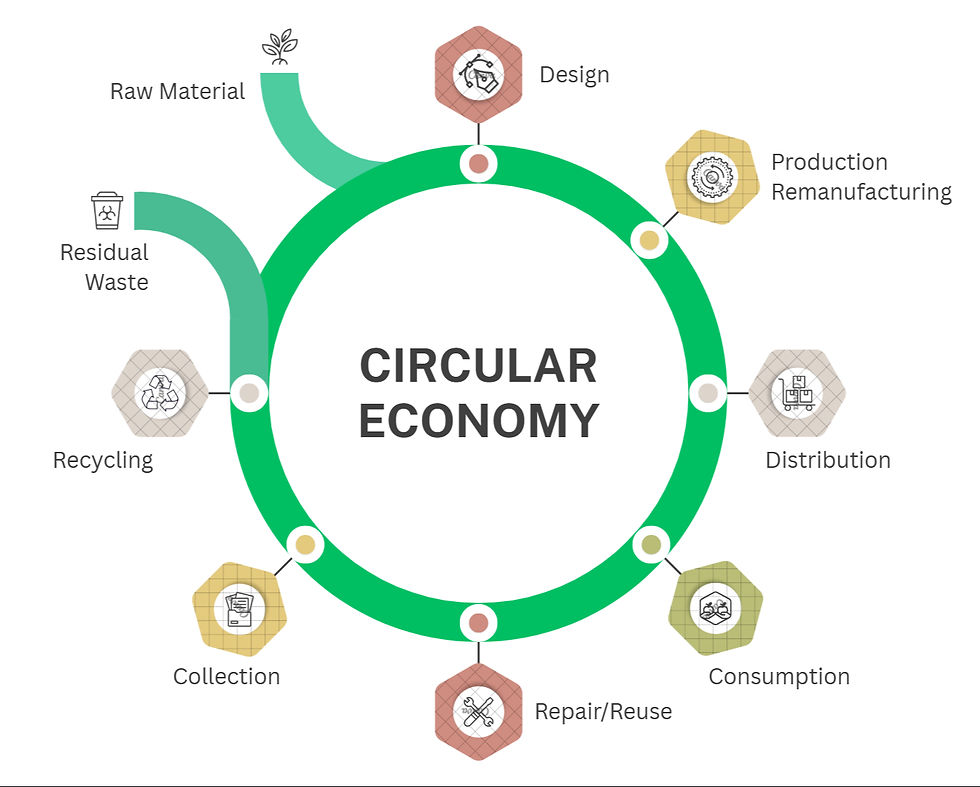
A new generation of climate-tech startups is now applying these principles in practice. By transforming waste into building materials, embedding carbon into concrete, and enabling large-scale reuse, they are not just reducing environmental impact — they are turning it into viable, scalable business models. The five companies below represent the most promising of this shift —
01 — CarbiCrete
Carbon-negative concrete: Turning emissions into stone
CarbiCrete, a Montreal-based Canadian company, has developed a method to produce cement-free, carbon-negative precast concrete products.
How It Works
CarbiCrete replaces cement with steel slag, an industrial by-product, and cures the material with CO₂. The reaction forms calcium carbonate, permanently locking carbon into the concrete.
Revenue Drivers
Licensing technology to concrete manufacturers
Carbon removal credits
Concrete product partnerships
Growth Areas
Scaling to 25,000 units per day.
U.S. market entry via Gagne & Son; licensing is active.
High-value revenue from permanent CO₂ removal.
CarbiCrete has raised over $40 million to scale its cement-free technology. Because the process is entirely cement-free, the company is insulated from rising cement costs, making it a preferred partner for major developers across North America and Europe.
Founded
2016
HQ
Canada
Founders
Dr. Mehrdad Mahoutian and Chris Stern
02 — Betolar
AI-enabled geopolymer binders from industrial waste
Founded in Finland in 2016, Betolar is on a mission to convert industrial waste into high-performance circular cement. Operating at the intersection of materials science and artificial intelligence, the company runs two core technology streams: metal extraction and its proprietary Geoprime geopolymer platform.
How It Works
Through its metal-extraction technology, Betolar recovers strategic metals from slag and mine tailings with 99% efficiency. The residual material from this process is then repurposed into low-carbon circular cement, meaning virtually nothing is wasted.
Converts unutilised industrial side streams into valuable materials
Produces low-carbon, high-performance binders
Reduces carbon emissions by up to 80% compared to traditional cement
Lessens dependence on virgin raw materials, advancing the circular economy
Revenue Drivers
Licensing the Geoprime AI platform
Industrial waste processing
Partnerships with concrete manufacturers
Growth Areas
Asian construction markets
More AI material optimization
Scaling low-carbon concrete production
Founded
2016
HQ
Finland
Founder
Juha Leppänen
03 — Carbon Limit
Self-decarbonizing concrete: Making buildings breathe.
A South Florida startup, Carbon Limit, has developed a groundbreaking concrete additive called CaptureCrete — a carbon-negative powder that actively absorbs CO₂ from the surrounding atmosphere.
How It Works
When mixed into concrete, CaptureCrete mineralises atmospheric CO₂ directly into the building's structure. This transforms every structure built with it into a permanent carbon sink — simultaneously reducing carbon footprints, strengthening the concrete, and generating verifiable, high-quality carbon credits.
The company licenses its formula to cement and concrete producers and manages the entire carbon credit generation and verification process on their behalf.
"We use special minerals from nature that actually give concrete the ability to attract CO₂ like a magnet into the concrete and then permanently store it inside there."
-Tim Sperry, Co-Founder, Carbon Limit
Revenue Drivers
Concrete additives for construction companies
Carbon credit generation through captured CO₂
Partnerships with infrastructure developers
The additive integrates easily into existing concrete production systems, giving it strong potential for commercialization in large infrastructure markets.
Growth Areas
Expansion into global concrete and infrastructure markets
Development of carbon-removal concrete technologies
Partnerships with construction material manufacturers
Founded
2020
HQ
USA
Founders
Oro Padron & Tim Sperry
04 — Concular
Circular construction: The digital marketplace for material reuse
Concular is a leading German PropTech company enabling the circular economy in construction by digitising building materials. Where most demolition projects end up in landfills, Concular's platform ensures that buildings are not demolished—they are deconstructed.
How It Works
Concular creates Digital Material Passports for every building on its platform. A permanent digital record that accompanies the material throughout its life.
What is a Digital Material Passport?
It means identifying a material's quality, origin, and location — but goes much further. It documents chemical ingredients, product compositions, recycling proportions, life cycle assessment figures, and recyclability data. These passports catalogue every beam, stone, panel, and fixture, allowing them to be tracked, valued, and resold on Concular's Circular Marketplace when a structure reaches the end of life. Nothing is wasted; everything is rehomed. All this simplifies both identifying the correct material and calculating the building's residual value, both circular and financial.
Impact: Upcoming EU 2026 regulations require full material traceability — making Concular's platform increasingly essential.
Revenue Drivers
Digital platform marketplace for reused materials
Construction project consulting
Circular building services for developers
Growth Areas
Digital platforms for circular construction supply chains
Expansion into European real estate and construction markets
Circular building consulting for developers
Why It Matters: By treating buildings as 'material banks' rather than future landfill, Concular is making the circular economy financially profitable for developers.
Founded
2020
HQ
Germany
Founders
Dominik Campanella (CEO), Julius Schaufele (CPO), & Marc Haines
05 — GreenJams
Upcycled masonry: Turning crop waste into climate action
GreenJams is an Indian startup founded in 2019 that produces Agrocrete — a carbon-negative construction material made from agricultural waste.
How It Works
By converting crop residue and industrial by-products into building blocks, GreenJams tackles two environmental problems simultaneously: agricultural waste burning and carbon-intensive construction.
Impact: By using crop residues, GreenJams prevents the air pollution caused by crop residue burning — which costs India almost $27 billion due to public health and worker productivity losses. In one year alone, the company prevented 600 tonnes of paddy straw from burning and removed 3,000 tonnes of CO₂ from the atmosphere.
Revenue Drivers
Manufacturing and selling Agrocrete blocks
Supplying sustainable construction materials to developers
Collaborations with infrastructure developers
Growth Areas
Scaling sustainable construction material production
Expanding into green infrastructure projects across South Asia
Advancing carbon-negative building technologies
GreenJams reported revenue of $120,000 USD as of March 2025 — early-stage, but meaningful validation in a market where climate-focused construction materials have historically struggled to achieve commercial traction.
Founded
2019
HQ
India
Founders
Varun Jami & Tarun Jami
Comparative Overview
Startups | Category | Core strategy | Key impact | Primary growth market | Revenue model |
CarbiCrete | Material | Cement-free, CO₂-cured concrete | Eliminates cement; stores CO₂ permanently | North America, Europe | Tech licensing + carbon credits |
Betolar | Material | AI-optimised waste-based binders | 80% lower carbon vs. cement | India, Canada, Australia | Platform licensing (SaaS) |
Carbon Limit | Material | Carbon-absorbing concrete additive | Structures become carbon sinks | Global infrastructure markets | Additive sales + carbon credits |
Concular | Lifecycle | Digital material passports + marketplace | Near-zero demolition waste | European real estate + construction | SaaS + marketplacecommissions |
GreenJams | Bio-circular | Agro-waste building blocks | Prevents crop burning; carbon-negative | South Asian infrastructure | Material manufacturing + supply |
The Bigger Picture
Across these five distinct technologies, a single pattern emerges: the most promising green construction startups are not just reducing waste — they are turning it into a business model. Carbon credits, AI-enabled licensing, and circular marketplaces are the new engines of the built environment.
The future of construction is no longer just about building taller or faster. It is about building smarter and more circularly. By transforming structures from carbon emitters into carbon sinks and from waste producers into material banks, these five startups are proving that the circular green economy is the only viable blueprint for our urban future.
Key Takeaways
Rethinking the material: CarbiCrete, Betolar, and Carbon Limit are decarbonising concrete at the production and performance level — each via a distinct, commercially proven mechanism.
Extending the lifecycle: Concular's platform treats existing buildings as material banks, creating value from demolition rather than waste — with regulatory tailwinds accelerating adoption.
Closing the bio-loop: GreenJams integrates agricultural waste directly into the construction supply chain — addressing rural pollution and urban emissions in a single product.
Stay ahead of the circular economy shift.
Deeper analysis across 12 construction markets, delivered monthly
Sources:
IEA Global Status Report for Buildings and Construction (2023) https://globalabc.org/sites/default/files/2024-11/global_status_report_buildings_construction_2023.pdf
Chatham House, "Making Concrete Change" (2018). https://www.chathamhouse.org/2018/06/making-concrete-change-innovation-low-carbon-cement-and-concrete
Ellen MacArthur Foundation, Circular Economy in Construction https://www.ellenmacarthurfoundation.org/topics/built-environment/overview
UNEP https://www.unep.org/resources/report/global-status-report-buildings-and-construction-20242025
Global Carbon Project https://www.globalcarbonproject.org/
Carbicrete https://carbicrete.com/
Betolar https://www.betolar.com/
Carbonlimit https://www.carbonlimit.com/
Concular https://concular.de/
Greenjams https://www.greenjams.org/
Article by-
Himani Jain


Well written
Good👍🏼
Nice👍🏻